
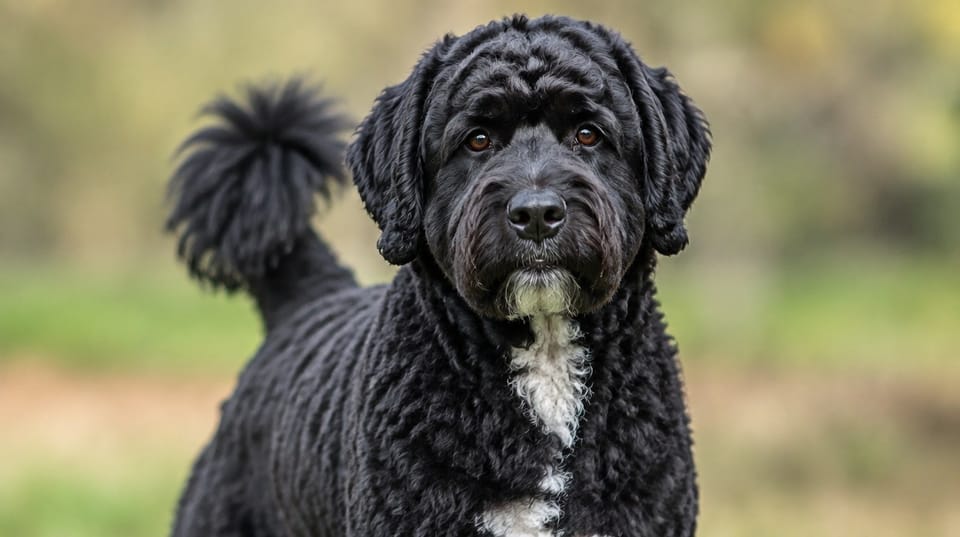
At a glance
- Group
- Working
- Size
- Medium
- Weight
- 35–60 lb
- Height
- 17–23 in
- Lifespan
- 11–13 years
Temperament
Portuguese Water Dogs were built to work a full day on a fishing boat, and a modern one wakes up every morning expecting that kind of schedule. For centuries they swam alongside the fleets of Portugal, driving fish toward the nets, fetching lost gear and carrying messages from boat to shore. The dog on your kitchen floor still has all of that stamina and all of that need to be useful.
At home he is affectionate, funny and very involved. He greets you with something in his mouth, follows you upstairs and leans on you while you cook. He is good with children and friendly with most visitors after a short look at them. Many are clowns who learn that a silly trick gets a laugh and then repeat it for years.
He is also a lot of dog. Young Porties jump up, carry things off and use their mouths more than most breeds, which is no surprise in a dog bred to retrieve. They stay puppyish until two or three years of age. If you have small children, expect a period where the dog is too bouncy for them and has to be managed.
He does not do well when ignored. A Portie left alone for long stretches, or given only a stroll around the block, will find his own entertainment: chewing, counter surfing and barking for attention.
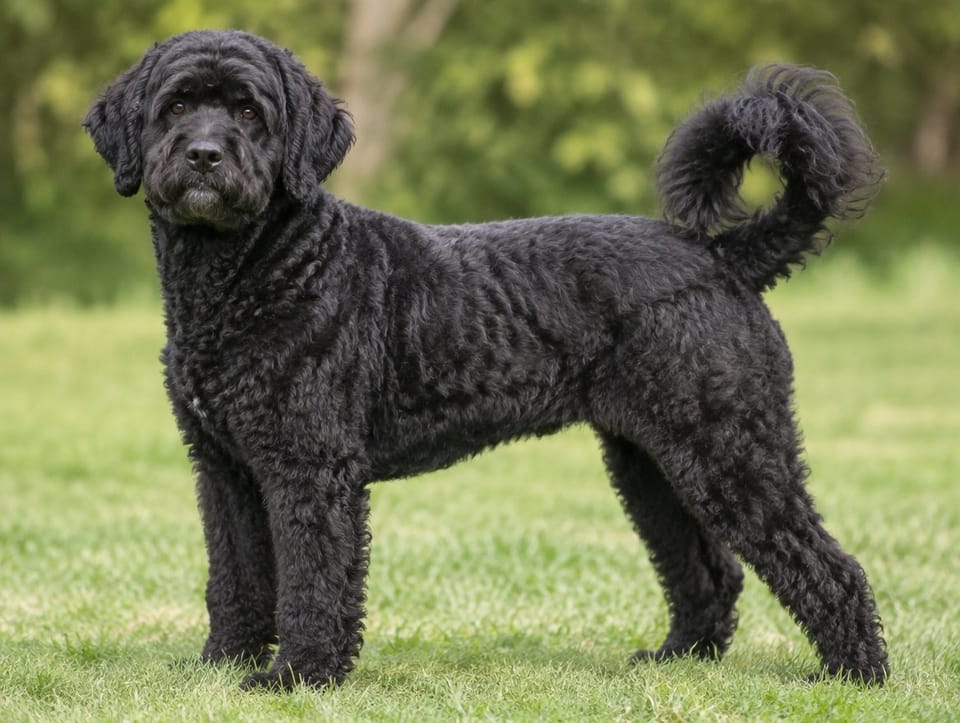
Exercise and activity
Count on at least an hour of real exercise every day, and 90 minutes is better for a young adult. A slow walk on a leash does not count for much. He needs to run, swim, fetch or work.
Water is where this breed is happiest. The Portie has webbed feet, a strong tail he uses as a rudder and a coat made for cold sea water. If you live near a lake, a river or a dog-friendly beach, swimming is the best exercise you can give him, and it is easy on his joints. Rinse and dry the coat afterward, and dry the ears.
On land, mix jogging, hiking, long games of fetch and off-leash running in a safe place. Then add work for his head. Porties do very well in obedience, agility, dock diving and the breed's own water trials. Fifteen minutes of training tires him as much as a much longer walk.
A Portie who gets enough exercise is a pleasant, settled housemate. One who does not is the dog people describe as "too much."
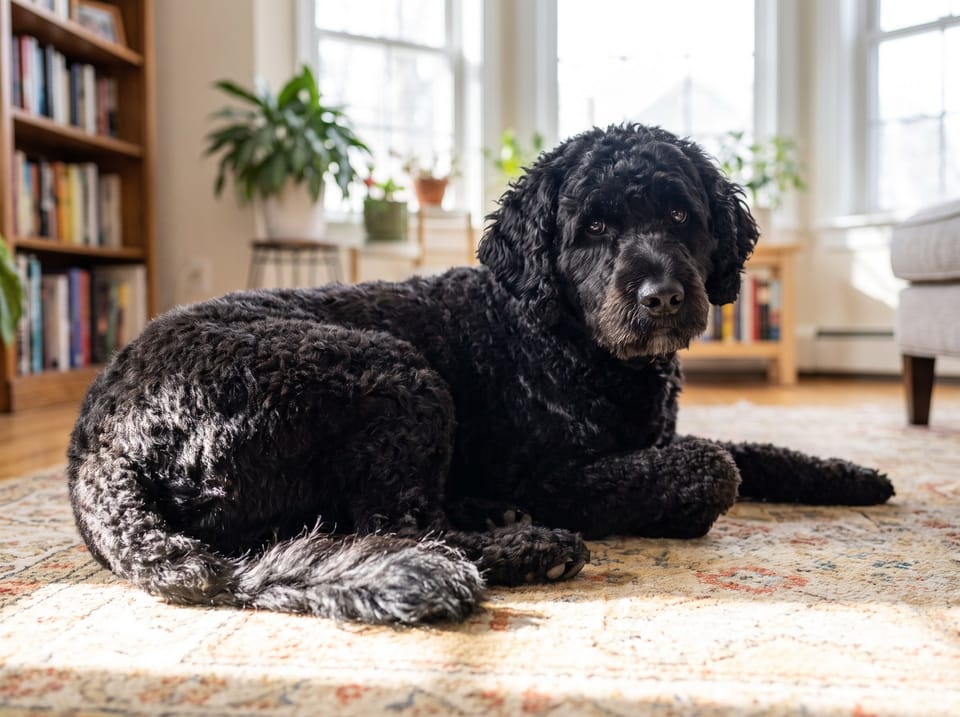
Grooming and shedding
The coat is the reason many people look at this breed, and it is also the part that surprises them. It is a single coat of hair that is either tightly curled or wavy, and it sheds very little. That makes a Portie easier to live with for some people with allergies, though no dog is free of allergens. Spend time with the breed before you decide.
Low shedding does not mean low upkeep. The hair keeps growing, and what falls out stays caught in the coat, where it turns into mats. Brush and comb right down to the skin two or three times a week, 20 minutes each time.
He also needs clipping every six to eight weeks. Most pet owners choose the retriever clip, which is about an inch long all over. The traditional lion clip leaves the front half long and the hindquarters and muzzle shaved. Budget for a professional groomer several times a year, or learn to use clippers yourself.
Check and dry his ears every week, and after every swim. Hairy drop ears that are often wet are prone to infection. Trim nails every three to four weeks and brush teeth several times a week.
Training
This is a clever, willing dog who learns quickly and remembers what he learns. He is also a thinker. If a Portie decides his way is better than yours, he will try it, and he will test whether a rule still applies today. Calm consistency works. So does keeping training interesting, because he gets bored by endless repetition.
Use rewards: food, toys and a chance to fetch. Harsh corrections make a sensitive dog shut down or argue. Keep sessions to ten minutes and stop while he still wants more.
Start with the things that cause trouble later. Teach him to keep four feet on the floor when he greets people, to give up what he is carrying, to walk without pulling and to settle on a mat. Work on the mouthing early by offering a toy every time he grabs a sleeve.
Go to a puppy class, and keep going with classes through his adolescence. Give him jobs at home as well. Many Porties learn to fetch the paper, carry the mail, put toys in a basket and find things by name.
Health watchlist
Portuguese Water Dogs usually live 11 to 13 years. The breed's parent club has been unusually open about its inherited problems, and there are DNA tests for several of them, which lets careful breeders avoid producing affected puppies.
Hip dysplasia, in which the hip joint forms poorly and becomes arthritic, occurs in the breed. So do inherited eye diseases, including two forms of progressive retinal atrophy that lead to blindness, and a syndrome in which puppies are born with abnormally small eyes.
Two serious diseases of young puppies are also known. One is a storage disease of the nervous system called GM1 gangliosidosis. The other is a heart muscle disease, juvenile dilated cardiomyopathy, that is fatal in very young dogs. Both can be avoided when breeders test the parents.
The Portuguese Water Dog Club of America recommends a hip evaluation, an eye examination by a specialist, and DNA tests for both forms of progressive retinal atrophy, the small-eye syndrome, GM1 and juvenile dilated cardiomyopathy. Ask the breeder to show you the results for both parents.
Addison's disease, a disorder of the adrenal glands, is seen more often in Porties than in most breeds. Ear infections are common in dogs that swim a lot.
Talk to your vet about ear care, a screening plan and anything in your dog's behavior that changes.
Is this breed right for you?
A great fit if
- you are active every day and want a dog to share it
- you live near water or love the idea of a swimming partner
- you want a low-shedding coat and accept the grooming that comes with it
- you enjoy training and would like to try a dog sport
- someone is home for much of the day
Think twice if
- you want a calm dog who is satisfied with a short daily walk
- the cost and time of regular clipping would be a burden
- you live in a small apartment with no easy access to open space
- jumping and mouthing in a young dog would worry you around small children
- the dog would be alone for a full working day
Similar breeds
 Poodle (Standard)A clever, athletic, low-shedding dog that learns fast and needs regular professional grooming.
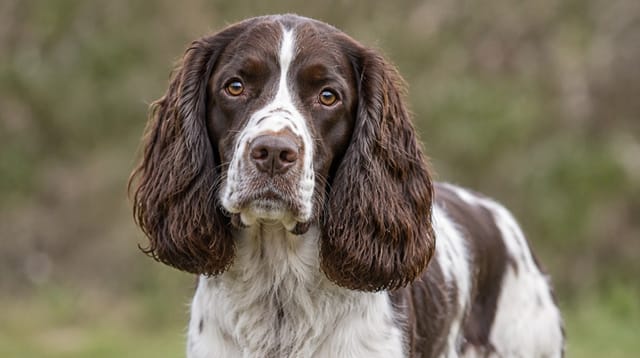 English Springer SpanielA merry, affectionate, easy-to-train gundog that needs plenty of exercise, company and ear care.
 Labrador RetrieverAn outgoing, tireless, food-loving retriever that is easy to train and needs a lot of daily exercise.