
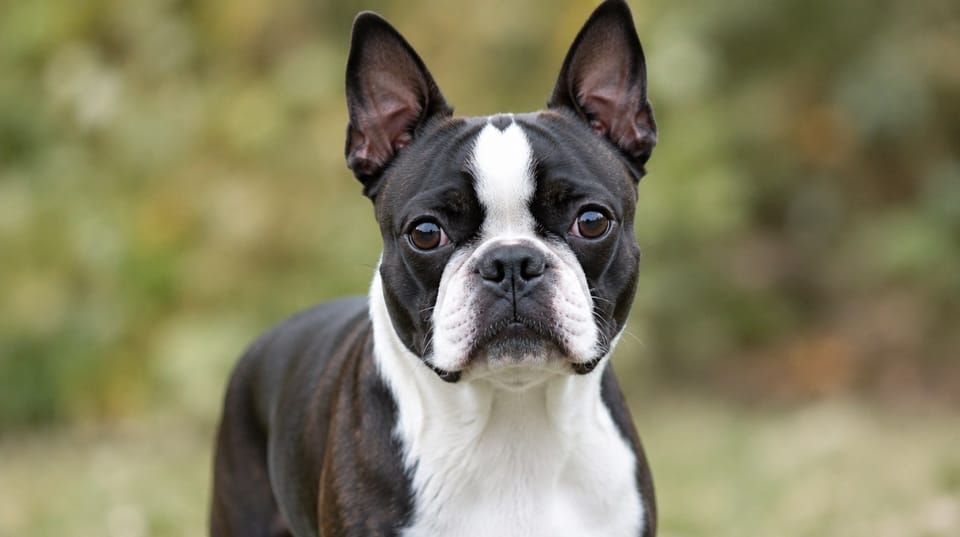
At a glance
- Group
- Non-Sporting
- Size
- Small
- Weight
- 12–25 lb
- Height
- 15–17 in
- Lifespan
- 11–13 years
Temperament
They call him the American Gentleman, partly for the tuxedo and partly for the manners. The Boston Terrier was created in Boston in the late 1800s and has been a companion dog ever since. He is a terrier mostly in name. What you get is a bright, comical, people-loving little dog who wants to be wherever you are.
A Boston is lively without being frantic. He has bursts of play, often tearing around the living room in what owners call zoomies, and then he curls up against you for the evening. He is affectionate with the whole family, good-natured with children and usually sociable with other dogs and cats. Most are friendly with strangers after a quick look.
He is not a big barker, which is one reason he does so well in apartments. He is, however, a noisy dog in other ways. Bostons snort, snore and grunt, and they pass gas with some regularity. That is the first hard part, and owners learn to laugh about it.
Bostons are sensitive to your tone and mood. A cross word can send one slinking off to his bed. They like company and do best when someone is around for much of the day, though a mature Boston can usually manage three or four hours alone.
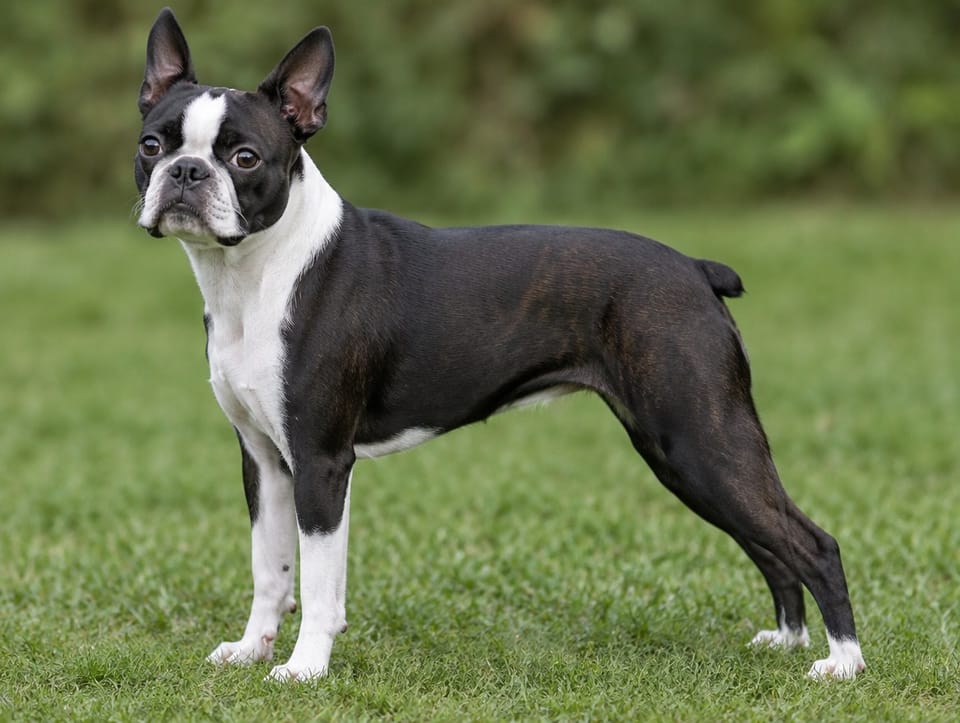
Exercise and activity
Plan on 30 to 45 minutes of walking a day, split in two, plus play. A Boston has more spring in him than a French Bulldog or a Pug, and he enjoys a brisk walk, a game of fetch down the hall and a wrestle with a tug toy. Many love chasing a ball and will keep it up as long as you will throw.
He is also adaptable. On a busy day he will accept a shorter walk and extra indoor games. Bostons do well in agility, rally, obedience and flyball, and they make cheerful therapy dogs.
The second hard part is weather. His short muzzle makes it harder to cool down by panting, so he can overheat fast. In hot or humid weather, walk early or late, keep it short, bring water and watch for heavy, noisy panting. His thin, short coat means he also feels the cold. Below freezing he will want a coat and a quick trip. He belongs indoors, in a climate-controlled home.
Use a harness instead of a collar. It keeps pressure off his throat and, if he pulls, off those large, prominent eyes.
Bostons are top-heavy, and many are weak swimmers. Supervise near water.
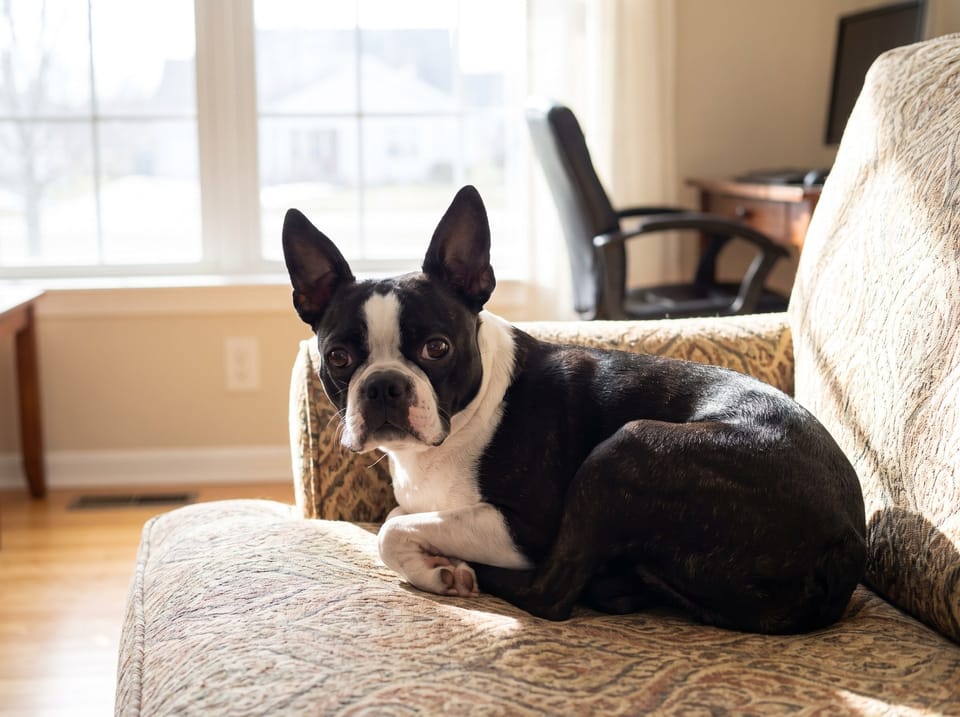
Grooming and shedding
Few dogs are easier to keep tidy. The coat is short, smooth and fine. Brush once a week with a soft brush or rubber mitt to lift loose hair, and bathe him every month or two. Bostons shed lightly, and the hair is short enough that you will not notice much.
The eyes are where you need to pay attention. They are large, round and exposed, and they pick up dust and scratches easily. Look at them every day. Wipe away any discharge with a soft, damp cloth, and see your vet promptly about redness, squinting or cloudiness.
Wipe the face and any folds around the nose a few times a week and dry them well. Check ears weekly. Trim nails every two to three weeks. They grow fast and are not worn down by short walks.
Brush his teeth several times a week, and daily if you can. The short jaw crowds the teeth, which makes dental problems more likely.
Training
Bostons are smart, attentive and keen to please, and they are among the easier small breeds to train. They learn tricks quickly and love an audience. A first-time owner can do very well with one.
Use praise, play and small treats, and keep your voice light. Because the breed is so sensitive, a gentle "no" followed by showing him what you want works far better than scolding. Sessions of five to 10 minutes, a couple of times a day, are plenty.
Some Bostons have a stubborn or excitable streak. The common complaints are jumping up on visitors and getting overexcited in play. Teach "sit" as his default way to say hello, and build in short calm-down breaks during games.
House training is usually straightforward with a consistent routine, though it can be slower than with larger breeds. Take him out often, reward him right away, and be prepared for some reluctance in rain and cold.
Socialize him early with people, dogs and everyday noises, and get him used to having his eyes, face and feet handled. Measure his food, too. Bostons love to eat, and extra weight makes breathing harder.
Health watchlist
Bostons often live 11 to 13 years, and many are healthy throughout. The breed's weak points follow from its head shape and its eyes.
Eye problems are the most common. The prominent eyes are prone to scratches and ulcers on the surface, and the breed is known for cataracts, including a hereditary form that appears in young dogs, as well as glaucoma, dry eye and cherry eye.
The short muzzle can narrow the airway. Many Bostons only snore, but some have real difficulty breathing in heat or during exercise, and short-faced dogs need extra care under anesthesia. Choose a puppy whose parents have open nostrils and breathe quietly at rest.
Deafness in one or both ears occurs in the breed and is more likely in dogs with a lot of white on the head. Kneecaps that slip out of place are seen, as are skin allergies and malformed vertebrae related to the short screw tail. Because of the large heads, many Boston puppies are delivered by cesarean section.
The Boston Terrier Club of America recommends that breeding dogs have a patella evaluation, an eye exam by a veterinary ophthalmologist and a hearing test known as BAER. Ask to see the results for both parents.
Standard colors are black, brindle or seal with white markings. Be cautious of breeders promoting "rare" colors such as blue, lilac or merle.
Talk to your vet about eye care, weight and breathing for your own dog.
Is this breed right for you?
A great fit if
- you live in an apartment or a small house
- you want a cheerful, affectionate dog who is easy to train
- this is your first dog
- you want a short coat that needs almost no grooming
- you have children or other pets and want a friendly small dog
Think twice if
- you live in a hot climate and do not have air conditioning
- snoring, snorting and gas would bother you
- you want a dog for long runs or all-day hikes
- you would be away for a full working day
- you are not prepared to check and care for his eyes daily
Similar breeds
 French BulldogA small, funny, people-loving companion that suits apartment life but struggles in heat and can be costly at the vet.
 PugA sturdy, comical, people-loving companion who suits apartments, sheds heavily and struggles in heat.
 Cavalier King Charles SpanielA sweet, gentle lap spaniel who suits almost any home, with a serious inherited heart risk.