
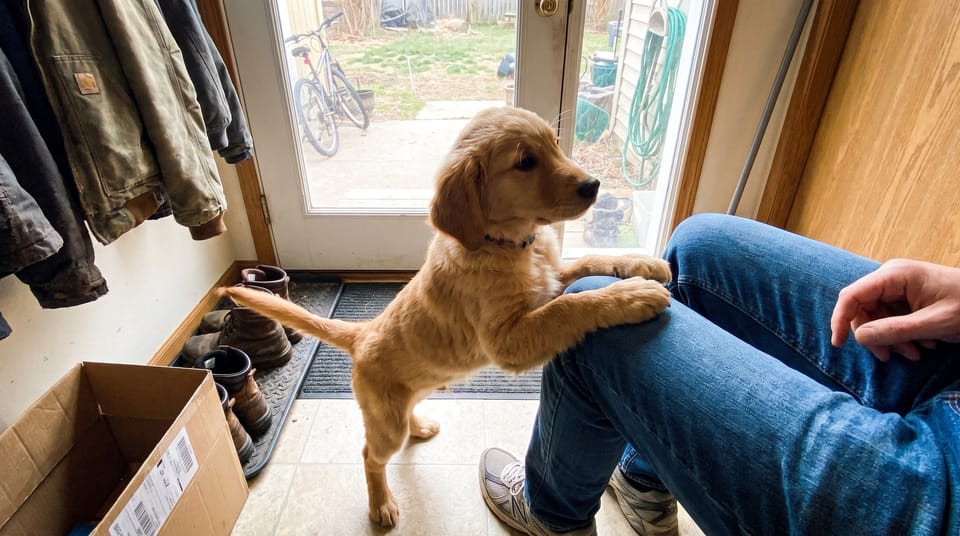
Your guest barely gets through the door before your dog plants two paws on their jeans. You reach for the collar, your guest laughs and starts petting, and your dog gets exactly what they wanted: a greeting.
You can change that pattern. Make four paws on the floor the thing that earns attention, and use a gate or leash to make arrivals manageable while your dog learns.
Start with the greeting you want
Dogs often jump to get closer to people and collect attention. Excitement makes waiting harder. Talking, touching, or laughing while your dog is jumping can keep the greeting going, even when the words are “get down.”
Start somewhere quieter than your front door. Have a few pea-sized treats ready and practice with someone your dog knows.
- Ask your helper to approach while your dog has four paws on the floor.
- Say “yes” as the person gets close, then give your dog a treat low enough that their paws stay down.
- Let your helper offer two seconds of gentle petting.
- If your dog jumps, have your helper pause the greeting and move just out of reach. Keep your hands quiet.
- When the paws land, say “yes,” reward low, and try a shorter greeting.
Do five repetitions, then take a break. One or two sessions of two minutes each day gives you a manageable starting point.
Your dog does not need to sit. Standing counts, and so does choosing to lie down. Reward before the jump whenever possible, so your dog practices staying grounded instead of a jump, land, treat sequence.
For guests arriving today, put a gate between your dog and the doorway before opening it. Reward paws on the floor from your side. You can practice the close greeting later, when everyone has settled.
Make the doorway easier to handle
The hard part is that real visitors are much more exciting than your practice helper. A dog who can greet someone quietly in the kitchen may still bounce at the sound of the latch.
Set up before anyone arrives. Put treats in a closed container you can reach, clear shoes out of the entry, and choose a waiting spot several feet from the door. A hallway gate works well if your dog is comfortable behind it.
You can also hold a leash attached to a comfortable harness. Keep enough slack for your dog to stand and turn, with enough distance that they cannot reach the guest. Use distance to prevent contact, rather than pulling your dog into position. Do not tether them unattended.
If your dog gets more worked up behind a gate, start farther from the entrance or use a familiar room with a food toy they already enjoy. They can join you later. Every arrival does not have to become a practice session.
Give the doorbell a small, repeatable routine
Practice the bell separately from a full visitor entrance. Ask a household member to help for three minutes when you are not expecting anyone.
- Start with your dog near their waiting spot and the front door closed.
- Have your helper ring once. If that is too exciting, begin with a soft knock.
- Toss three small treats onto the floor at the waiting spot.
- While your dog eats, touch the door handle without opening it.
- Reward again if your dog stays at the spot, then finish the repetition.
Try three to five repetitions. Over the next few days, add one small change at a time: turn the handle, crack the door, then open it wider. Your helper stepping inside is another separate step.
Move forward when your dog can manage the current version for several repetitions. If they rush toward the door or stop taking treats they usually want, make the next attempt easier. Increase the distance, reduce the sound, or leave the door closed.
With an actual guest, use the same order: bell, waiting spot, treats, door. Keep the gate closed or the leash in hand while the guest enters and takes off their coat. Greeting comes afterward.
Tell visitors exactly how to help
Brief your visitor before they arrive. A text is easier than trying to explain over barking.
You could write: “We’re practicing greetings with paws on the floor. Please come in quietly and let me get you settled first. When I bring her over, pet her briefly while her paws stay down. If she jumps, pause and give us room to reset.”
Keep the treats with you initially. A visitor holding food near their chest can accidentally give your dog another reason to spring upward.
Some people will say they do not mind jumping. You can appreciate that and still explain that you need the same greeting for everyone. Children and people who might lose their balance should have space behind a barrier while you manage your dog.
Reset when excitement wins
If your dog lands on a guest, calmly create space with the leash or guide them away with a treat tossed behind them. Return to the waiting spot and reward a few seconds of paws on the floor before deciding whether to try again.
If every approach produces another jump, stop the close greetings for that visit. Let your dog settle in their comfortable space with something to do.
Keep a quick note after practice: who visited, how close they got, and whether your dog kept their paws down. That helps you choose the next step. If a quiet entrance worked but an enthusiastic greeting did not, ask your next helper for a quiet entrance again.