
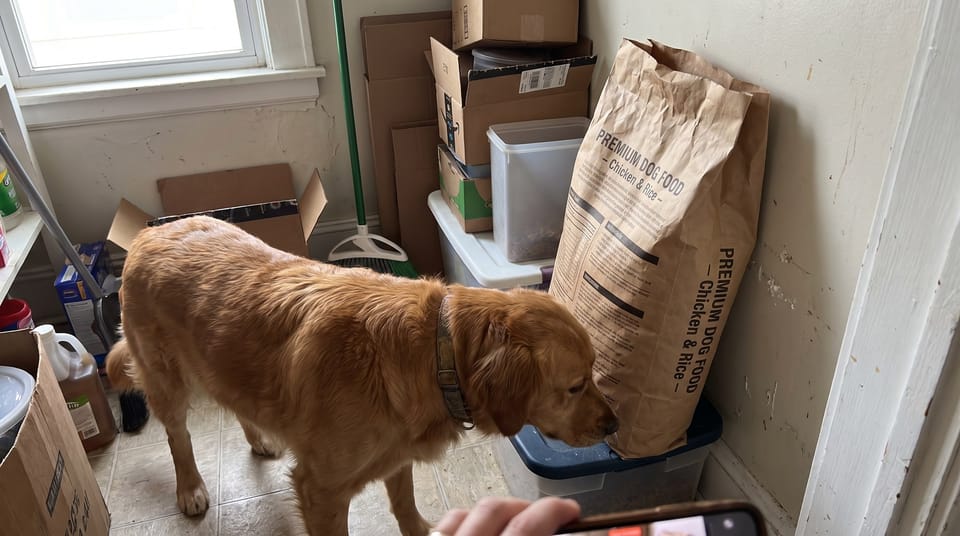
You turn a bag of kibble around, looking for something useful, and find tiny print, a long ingredient list and a feeding chart that seems to cover every dog except yours. Meanwhile, your dog is sniffing the bag like the decision is already made.
Give yourself three minutes with the back and sides of the package. You can learn more from a few plain sentences there than from the big promises on the front.
Start with the complete and balanced statement
Before comparing ingredients, find the nutritional adequacy statement. It is often tucked near the ingredient list or guaranteed analysis. Look for wording that says the food provides complete and balanced nutrition, followed by the life stage it covers.
That statement tells you whether the food is intended to supply the nutrients needed as a regular diet for that stage. The label may explain that the food was formulated to meet established nutrient profiles or that feeding tests support its adequacy. These are different ways of supporting the statement, not a simple ranking of good and bad foods.
If you see “for intermittent or supplemental feeding only,” pause. That product is not intended to serve as your dog's sole everyday diet. It might be a topper, a treat or a food used for a particular purpose under veterinary guidance.
For a quick first pass:
- Find the complete and balanced statement.
- Check that the named life stage fits your dog.
- Find the daily feeding amount and calories per cup or container.
- Read the ingredients after those basics are settled.
If you cannot find the adequacy statement, ask the manufacturer where it appears before choosing the food as your dog's main meals.
Match the life stage to the dog at your feet
“Adult maintenance” is meant for adult dogs. “Growth” is meant for puppies. Pregnancy and nursing have their own nutritional demands, which may appear as “gestation and lactation” on the label.
“All life stages” includes growth and reproduction. It does not mean every dog needs the same portion, or that the food is automatically the best fit for a less active adult.
If your puppy is expected to become a large dog, read the entire adequacy statement. Look for wording that specifically includes growth of large-size dogs. Some statements explicitly exclude that use. The puppy picture on the front does not settle the question.
Words such as “senior” on the front also need a closer look. Read the adequacy statement underneath the marketing, then consider your dog's actual needs.
Your vet belongs in this decision if your dog is growing, pregnant, nursing or living with a health condition that affects food choices. Bring a picture of the full label so you can discuss the exact food.
Read ingredients without turning them into a scorecard
Ingredients are listed by weight when they are added, including their water content. A fresh meat ingredient carries water with it, while a dried ingredient has much less. That makes the first ingredient less useful as a stand-alone quality test than it may seem.
You may also notice several ingredients from the same source, such as different parts of a grain or pea. Each appears separately. Their positions do not tell you the total contribution of that source.
The list helps you identify ingredients, but it cannot tell you how well the whole recipe meets your dog's needs. An unfamiliar vitamin name is not a reason to reject a food. Neither is a familiar ingredient proof that the finished diet is a good fit.
The guaranteed analysis is another piece of the label, usually showing minimum protein and fat and maximum fiber and moisture. Those are limits, not exact amounts in every serving. Comparing the printed protein numbers on wet food and kibble can mislead you because their water content differs.
If you are investigating a suspected food reaction, take the label to your vet. Switching between foods based only on the first ingredient can make the pattern harder to sort out.
Treat the feeding guide as a starting point
The hard part is that a feeding chart cannot know your dog's activity, body condition or daily extras. Start by checking whether the amount shown is per day, then divide it among meals.
If the guide suggests two cups daily and you feed twice a day, that is one cup per meal. Use a level measuring cup rather than a heaped scoop. If the label gives grams, a kitchen scale makes portions easier to repeat.
Find the calorie statement too. “kcal” means Calories in this context. Two foods can provide different calories in the same cup, so do not automatically carry the old portion over to a new bag.
Write down meals, treats and toppers for three days. This gives you something concrete to review if weight starts drifting. Ask your vet for help setting portions if your dog is gaining or losing weight unexpectedly.
Give the front-of-bag promises less attention
“Premium,” “gourmet” and similar words do not tell you whether a food matches your dog. “Natural” does not replace the adequacy statement. “Grain-free” describes an ingredient choice, not a promise of better nutrition.
Before throwing away the bag, save the lot number, best-by date and manufacturer contact details. Keep the label handy while introducing the food.
If your dog develops vomiting, persistent diarrhea or a loss of appetite, contact your vet instead of repeatedly switching bags. Your notes about portions, timing and the exact food will make that conversation more useful.