
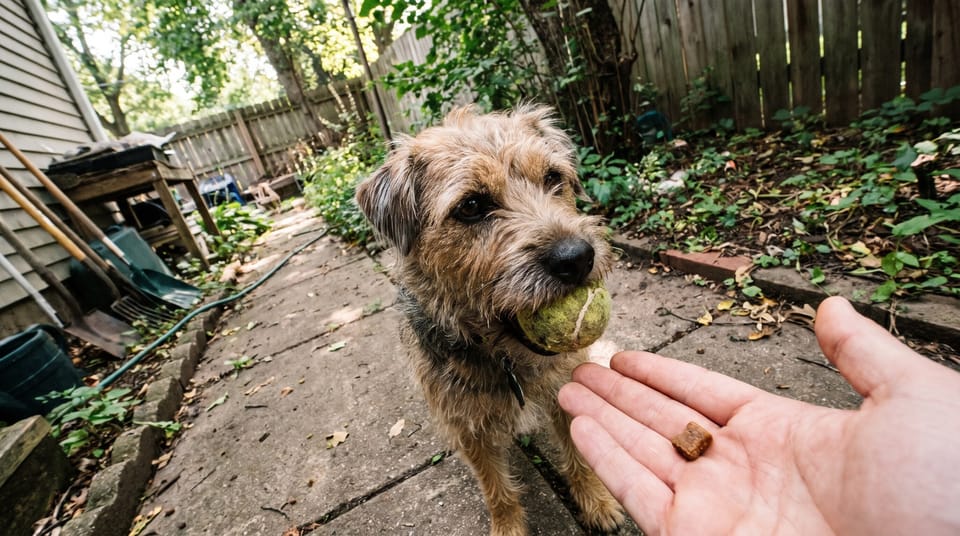
Your dog finds a crumpled wrapper beside the sidewalk, and suddenly your quiet walk becomes a negotiation. You reach down. Your dog ducks away. Now that wrapper seems much more interesting than it did a moment ago.
Two cues give you something useful to do before the chase begins. “Drop it” means release what is already in your mouth. “Leave it” means turn away from something before you take it. Teach them separately, with easy objects and rewards worth accepting.
You do not need to practice with anything dangerous. Start indoors with a boring toy, a few pea-sized soft treats, and two quiet minutes.
Start with a trade your dog wants
Choose a sturdy toy your dog will hold but does not treasure. Skip socks, stolen belongings, and favorite chews for now. The object should be too large to swallow and safe for supervised play.
For your first session, let the trade do the teaching:
- Offer the toy and let your dog take it without pushing it toward their mouth.
- Bring a treat close enough for your dog to notice. Keep your other hand still instead of reaching for the toy.
- When your dog releases the toy, say “yes” and give the treat.
- Pick up the toy once your dog has moved away from it, then offer it back if they still want it.
- Repeat three to five times, then finish.
Returning the toy matters. Your dog gets to learn that letting go often earns a snack and another turn with the toy.
If your dog will not release it, try a better treat or a less interesting toy next time. Do not tug, pry the mouth open, or follow your dog around. If they abandon the toy and only watch your treat hand, that is fine. End the session and try again later.
That first easy trade is useful even before either cue is learned. Keep treats handy so you can offer an exchange instead of grabbing.
Give “drop it” a clear meaning
Once your dog readily releases the toy for a treat, say “drop it” once, just before you present the treat. Practice three to five exchanges per session, once or twice a day.
After several successful sessions, say the cue and pause for a second before moving your treat hand. If the toy falls, mark it with “yes” and reward from your pocket. You are gradually teaching your dog to respond to the words without needing to see the payment first.
If nothing happens, show the treat and make the exchange easy again. Avoid repeating “drop it” while your dog keeps chewing. That gives you plenty of practice saying the cue without giving your dog much useful information.
Over the next few days, try a second safe toy, then another room. Change one thing at a time. A successful trade in the kitchen does not mean your dog is ready to surrender a fascinating sidewalk find.
Sometimes the reward can be another round of play. Keep food rewards available, especially when the object is harder to give up.
Teach “leave it” without a struggle
For this cue, the reward comes from you, not from the thing your dog was asked to ignore.
Sit with one ordinary treat inside a closed fist and a better treat in your other hand, held behind your back. Present the closed fist at a comfortable distance.
- Let your dog notice your fist. Keep it closed and still.
- The instant your dog moves their nose away, say “yes.”
- Give the better treat from your other hand, away from the closed fist.
- Reset and repeat up to five times.
You are looking for a small choice to disengage, not a long stare into your eyes. If your dog paws hard, mouths your hand, or gets frustrated, stop. Next time, use a less tempting treat and reward an earlier moment of backing away.
Once your dog starts turning away promptly, say “leave it” just before presenting your fist.
Next, practice with a boring object on the floor, far enough away that your dog can notice it without immediately grabbing it. Say the cue once and reward turning toward you. If your dog cannot turn away, increase the distance. Keep these sessions to one or two minutes.
Take both cues on walks
Start outside in a quiet spot with treats ready. Practice around an ordinary leaf or another harmless distraction before expecting success near discarded food.
When your dog notices something ahead, say “leave it” while there is still room to pass. Reward beside your leg as you move away together. Distance helps, so cross the sidewalk or turn around when a temptation looks too difficult.
If the object is already in your dog’s mouth, use “drop it” and offer a trade. Once it falls, reward a few steps away so you have space to retrieve it safely.
The hard part is spotting things early. Keep the leash short enough to prevent access to litter while leaving comfortable slack. Neither cue replaces watching where your dog’s nose is going.
When a find matters too much
A stolen treasure can be much harder to surrender than a practice toy. Avoid cornering your dog or reaching over their head. If it is safe to wait, give them space and offer a better trade.
Freezing, stiffening, or growling around an object means you should stop reaching. Arrange help from a reward-based behavior professional before practicing more exchanges around valued belongings.
If your dog has swallowed something potentially dangerous, contact your veterinarian promptly. Practicing the cue again can wait.
At your next ordinary session, return to the easiest toy. Make three comfortable trades, give the toy back, and let that be enough for the day.