
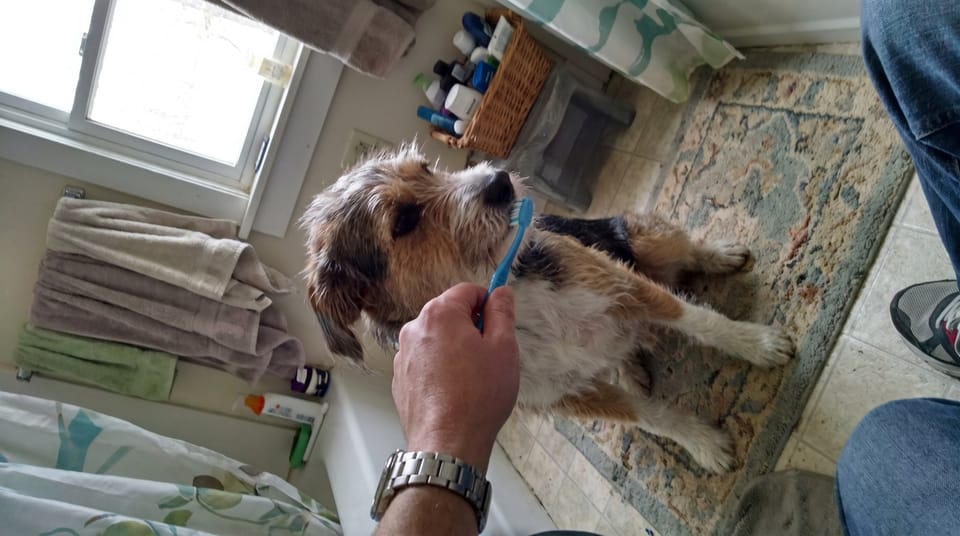
Your dog sees the toothbrush and leaves. You follow, toothpaste in hand, already wondering whether this counts as exercise. By the time you reach the couch, neither of you wants anything to do with dental care.
Make the job smaller. You can start with a lick of dog toothpaste, move to a brief finger touch, and gradually work toward thirty seconds of gentle brushing on the outside surfaces. You do not need to pry your dog's jaws apart.
Thirty seconds is a starting point, not a complete cleaning. The first job is making brushing something you can repeat without a chase.
Start with a lick and one small touch
Choose toothpaste labeled for dogs. Human toothpaste is not suitable for this job, and some products contain ingredients that are dangerous for dogs. Set out a small, soft toothbrush meant for dogs, but leave it unused at first.
Pick a quiet moment when your dog is awake and relaxed. Sit beside them on a nonslip surface with room for them to move away. You can use the bathroom mat, but the living room rug works if the bathroom already means trouble.
Try this short sequence:
- Offer a small smear of dog toothpaste on a clean fingertip for your dog to lick.
- If your dog stays loose and interested, briefly touch the side of their lip with your other hand.
- Reward that moment with praise or a small treat, then finish.
Keep the whole attempt under a minute. For the first two or three days, that may be enough. If your dog willingly accepts the lip touch, lift the lip slightly and let a clean fingertip touch one outside tooth for a second. Keep your finger outside the teeth, never between the jaws.
Toothpaste tasting alone does not clean teeth. It gives you an easy, pleasant place to begin. If your dog pulls away, let them. Next time, return to the last step they accepted comfortably.
If you notice bleeding, a broken tooth, swelling, or apparent mouth pain, stop and call your vet before continuing.
Let your finger introduce the brush
The hard part is often getting past the lip. Your dog may love toothpaste and still dislike a hand near their mouth. Those are separate hurdles, so give each one time.
Over the next few sessions, try gently moving your fingertip across one or two outside teeth. A session can be just two brief touches, each followed by a reward. Move forward when your dog stays relaxed and willingly sticks around, rather than because a certain number of days has passed.
Keep your nails short and your touch light. If your dog tends to snap at fingers or seems worried about your hands, skip the finger rubbing and ask your vet about a safer approach.
Once those touches are comfortable, offer a lick of toothpaste from the soft brush. At another session, touch the bristles to one outside tooth, then reward and stop. You can spend several days here.
Avoid holding the muzzle shut or pinning your dog in place. You need their cooperation tomorrow, too.
Make thirty seconds easy to repeat
When your dog accepts the brush, lift the lip gently and brush the surfaces facing the cheeks and lips. The mouth can stay mostly closed. Use small, gentle motions, with the bristles reaching the edge where tooth meets gum without digging into it.
Build toward this simple routine:
- Spend about fifteen seconds on the outside teeth on one side.
- Pause and let your dog relax.
- Spend about fifteen seconds on the other side, then give a reward.
You can break that into shorter turns. Five comfortable seconds are a useful step toward thirty. Reach the back teeth as your dog allows, and include both upper and lower outside surfaces over time.
Aim for daily brushing. Once thirty seconds feels ordinary, gradually extend the time so you can cover the teeth more thoroughly. Ask your vet to show you where to focus at your dog's next visit.
Keep the supplies together somewhere convenient and out of your dog's reach. Pair brushing with a cue you already remember, such as your own evening toothbrushing. Rinse the brush afterward and let it air-dry.
When the routine falls apart
If your dog chews the brush, pull it back when they release it and try a shorter touch next time. Do not turn it into tug. Replace a brush with damaged or loose bristles.
If the toothpaste gets a firm rejection, try a different dog toothpaste flavor. You can also practice the lip touch separately, rewarding afterward with a familiar treat.
If your dog freezes, turns away repeatedly, growls, or tries to escape, end the session. A still dog is not necessarily a comfortable dog. Go back to an easier step next time, and do not punish a growl.
Missing a day does not call for a longer session tomorrow. Resume at the level your dog accepts.
Know when the mouth needs a vet
Brushing cannot remove hard, stuck-on tartar or fix a painful tooth. Do not scrape deposits with tools or scrub harder to shift them.
Arrange a vet visit for persistent bad breath, red or swollen gums, bleeding, a loose or broken adult tooth, unusual drooling, or pawing at the mouth. Dropping food, chewing on one side, or suddenly resisting a previously comfortable brushing routine also deserves a call. A dog may keep eating even when their mouth hurts.
Call promptly if your dog has facial swelling, substantial bleeding, or cannot eat or drink. Trouble breathing needs emergency veterinary care.
Until your vet can advise you about a sore mouth, leave brushing alone. Make a note of what you noticed and when it started, including changes at meals. Those everyday details are useful when you call.